
Walking into a CPR training classroom can feel surprisingly intimidating. The room is often sterile, lined with rows of faceless plastic mannequins staring blankly at the ceiling. For many, this environment triggers a quiet but potent wave of anxiety. It isn’t just the fear of the unknown; it is the heavy weight of responsibility. The thought, “What if I have to use this?” sits in the back of your mind, accompanied by the even scarier question, “What if I fail?”
If you need flexible training from home, our online cpr and first aid program lets you learn lifesaving skills at your own pace.
CPR training anxiety is a very real, very common phenomenon. It stems from a deep desire to be helpful, clashing with the fear of inadequacy. However, this anxiety doesn’t have to be a barrier. Instead, it can be reframed as a sign that you care—that you take the potential of saving a life seriously. By acknowledging these fears and equipping yourself with the right mindset, you can transform that nervous energy into focused confidence, turning a daunting class into an empowering experience.
Deconstructing the Fear: Why We Feel Anxious
To conquer anxiety, we must first understand its roots. Most people aren’t afraid of the mechanics of CPR; pressing on a chest is physically straightforward. The fear is psychological. It is the “Performance Anxiety of the Worst Case Scenario.” We imagine a chaotic emergency—a loved one collapsing at Thanksgiving dinner or a stranger falling on a subway platform—and we picture ourselves freezing.
Complete your cpr and first aid certification online quickly and conveniently with our nationally recognized courses.
This visualization of failure creates a mental block before the class even begins. We worry about embarrassing ourselves in front of the instructor, looking clumsy during the practice drills, or accidentally “hurting” the mannequin. Recognizing that these fears are hypothetical monsters is the first step. The classroom is a safe harbor designed specifically for making mistakes so that you don’t make them in the real world.
Shift Your Perspective: From “Test” to “Practice”
One of the most effective ways to lower your heart rate is to change how you view the training. Many students approach a CPR class like a high-stakes final exam. They feel they must memorize every statistic and execute every compression perfectly on the first try. This perfectionism is a trap.
We proudly offer spanish cpr classes to ensure more members of the community can access lifesaving education.
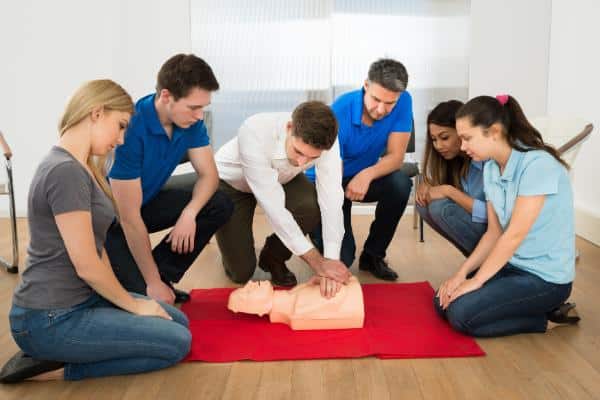
Instead, view the class as a laboratory. It is a place to experiment, to feel the resistance of the chest, and to find your rhythm. Your instructor is not a judge looking to fail you; they are a coach wanting to equip you. Every time you are corrected—”push a little harder” or “speed up”—it is not a reprimand; it is a calibration. Embrace the learning curve. You are there to build muscle memory, not to win a gold medal.
The Power of “Hands-Only” Simplicity
For decades, CPR training involved complex sequences of counting, breathing, and checking pulses. This complexity was a major source of anxiety. “What if I forget the ratio? What if I can’t find the pulse?” The good news is that modern science has simplified the process significantly. The widespread adoption of “Hands-Only CPR” for adult victims has stripped away much of the confusion.
Remind yourself that the core of saving a life is now incredibly simple: Call 911 and push hard and fast in the center of the chest. You don’t need to be a mathematician or a doctor. You just need to be a temporary heart. Focusing on this simplicity can act as a mental anchor, grounding you when your thoughts start to spiral into “what ifs.”
Exposure Therapy: Familiarity Breeds Confidence
Fear often thrives in the unknown. If the idea of touching a mannequin or using an AED (Automated External Defibrillator) freaks you out, exposure is the cure. Before your class, spend some time watching videos of the process online. See what the mannequins look like. Listen to the voice prompts of an AED.
When you arrive at the class, don’t hide in the back row. Step up to the mannequin early. Put your hands on it. Press down to feel the resistance. The more tactile familiarity you have with the equipment, the less alien it becomes. By the time the formal drills start, the mannequin will just be a tool, not a symbol of life and death.
Breathe Through the Stress
It sounds cliché, but physical relaxation triggers mental relaxation. If you feel your chest tightening or your palms sweating during the class, take a moment to practice “tactical breathing.” Inhale for four seconds, hold for four, exhale for four. This signals your parasympathetic nervous system to calm down.
Remember, you are in a controlled environment. No one is dying in that classroom. You have time to breathe, think, and ask questions. If you feel overwhelmed, tell your instructor. They have seen it a thousand times and can offer reassurance or a quick break. You are not alone in your nervousness.
Focus on the “Why”
Finally, the ultimate antidote to anxiety is purpose. When fear whispers, “You might mess up,” let your purpose shout back, “I might save a life.” Shift your focus from your own performance to the potential person you could help. That person doesn’t need a perfect paramedic; they need someone who is willing to try.
Your clumsy, imperfect, adrenaline-fueled CPR is infinitely better than doing nothing at all. By attending the class, you are already defeating the bystander effect. You are choosing to be a helper. Let that noble intention drive you through the discomfort, knowing that on the other side of this anxiety lies the power to make a difference.