
For decades, the path to learning Cardiopulmonary Resuscitation (CPR) was rigid and predictable. It meant sacrificing a precious Saturday, driving across town to a community center, and sitting in a fluorescent-lit room for hours. While the value of the skill was undeniable, the friction of the process was a barrier. Many people who wanted to learn simply couldn’t find the time or the childcare to make it happen.
If you need flexible training from home, our online cpr and first aid program lets you learn lifesaving skills at your own pace.
Virtual CPR Training
Enter the digital age. Virtual CPR training has shattered these barriers, bringing life-saving education out of the classroom and into the living room. This isn’t just a watered-down version of the “real thing”; it is a robust, flexible, and surprisingly effective evolution of emergency preparedness. By leveraging technology, we are democratizing access to these critical skills, allowing busy parents, remote workers, and rural residents to become the lifesavers their communities need.
Flexibility: Learning on Your Own Timeline
The most immediate benefit of virtual training is the gift of time. Traditional classes operate on a fixed schedule that rarely aligns with the chaotic reality of modern life. If the class is at 9:00 AM and you work the night shift, you’re out of luck. Virtual sessions, however, bend to your will.
With on-demand video modules, you can learn the theory of chest compressions at midnight after the baby falls asleep, or during your lunch break on a Tuesday. This “micro-learning” approach allows you to digest complex medical concepts at your own pace. You can pause, rewind, and re-watch a segment on AED usage until you truly understand it—something you can’t easily do in a crowded classroom with a schedule to keep.
The Comfort of a Low-Pressure Environment
Let’s be honest: role-playing a medical emergency in front of twenty strangers can be awkward. Performance anxiety is real. Many students in traditional classes hesitate to ask “stupid questions” or feel self-conscious when practicing on a mannequin while others watch. This anxiety can hinder learning.
Virtual training creates a psychological safe harbor. You are in your own home, wearing your own clothes, in a familiar environment. This comfort lowers the barrier to engagement. You can practice the mechanics of hand placement on a pillow or a training kit without the fear of judgment. When the mind is relaxed, retention improves. You aren’t worrying about how you look; you are focusing entirely on what you are doing.
Cost-Effectiveness and Accessibility
For businesses and large families, the cost of traditional certification can add up quickly. Virtual options often come with a lower price tag because they eliminate the overhead of renting a venue and paying for a live instructor’s travel time. This affordability makes it easier for a family of four to get trained together, transforming safety into a household project.
Furthermore, virtual training erases geographical boundaries. If you live in a rural area where the nearest training center is an hour away, virtual sessions bring the expert to you. It ensures that zip codes do not determine survival rates. Whether you are in a high-rise in Manhattan or a farmhouse in Montana, the quality of instruction remains the same.
The “Blended Learning” Advantage
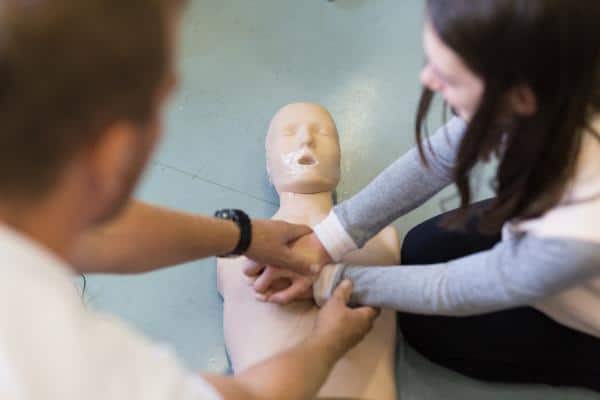
Critics often ask, “But how can you learn a physical skill online?” The answer lies in the “blended learning” model. Most reputable virtual courses combine online cognitive learning with a hands-on skills verification. After completing the video modules, students receive a “mannequin kit” in the mail or visit a local evaluator for a brief, 15-minute skills check.
Some advanced programs even use AI-powered apps that utilize your phone’s camera to track your hand movements on a couch cushion, providing real-time feedback on your compression rate. This hybrid approach gives you the best of both worlds: the convenience of digital theory and the confidence of physical practice.
Consistency of Curriculum
In a live classroom, the quality of your training is heavily dependent on the instructor. One might be engaging and thorough, while another might be tired and skip over sections. Virtual training guarantees a standardized “gold standard” curriculum. Every student watches the exact same high-quality videos, hears the same explanations, and passes the same quizzes.
This consistency is vital for corporate compliance. A company with offices in five different states can ensure that every employee, from the CEO to the intern, has received the exact same level of training, reducing liability and ensuring a uniform safety culture across the organization.
Empowerment through Repetition
Finally, virtual training materials don’t disappear after the class ends. In a traditional course, you leave with a card and a fading memory. With digital access, you can revisit the materials anytime. If six months pass and you feel rusty on the steps for infant choking, you can log in and watch that specific 3-minute video again.
This ability to refresh your memory on demand changes CPR from a “one-and-done” event into a continuous state of readiness. It keeps the knowledge fresh, the confidence high, and the rescuer ready.